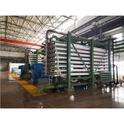
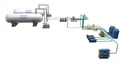
The working principle of the reverse osmosis seawater desalination system is to use the reverse osmosis membrane separation technology, and the membrane with selectivity to the permeated substances becomes a semi-permeable membrane. Generally, a membrane that can only permeate a solvent but not a solute is regarded as an ideal semipermeable membrane.
The size of the osmotic pressure depends on the type of dope, and the concentration and temperature are related to the properties of the semipermeable membrane. If a pressure greater than the osmotic pressure is applied on the concentrated solution side, the solvent in the concentrated solution will flow to the dilute solution, and the flow direction of this solvent is opposite to the original infiltration direction. This process is called reverse osmosis.
The reverse osmosis seawater desalination treatment device has the following characteristics:
1. The device has compact structure, small volume and simple installation.
2. The seawater desalination treatment equipment is easy to operate and maintain, and it is easy to manage without disassembly for cleaning and maintenance.
3. The system does not have high requirements on the inlet water temperature. As long as the seawater at any normal temperature between 5°C and 45°C can be used for desalination, and the marine equipment is generally equipped with low power, the main engine and auxiliary engine work.
The pretreatment of water supply in seawater desalination equipment process is the key to ensuring the long-term stable operation of the reverse osmosis system. When formulating the seawater pretreatment plan, the existence of a large number of microorganisms, bacteria and algae and other impurities in seawater should be fully considered. The growth of microorganisms will not only bring a lot of troubles to water intake facilities, but also directly affect the normal operation of seawater desalination equipment and seawater desalination projects. Periodic high tide and low tide, a large amount of sediment is entrained in the seawater, and the turbidity changes greatly, which is easy to cause unstable operation of the seawater pretreatment system. Seawater is highly corrosive, so the materials of the equipment, valves, and pipe fittings used in the system must be screened to ensure good corrosion resistance.